What is Chado?
Chado (茶道) or the Japanese Way of Tea, commonly referred to as Japanese tea ceremony, is a traditional, ritualized practice of preparing and serving matcha tea alongside Japanese sweets. It fosters mindfulness, harmony, and hospitality. Rooted in Zen Buddhism, it is a world of endless beauty, fascination and spirituality for those who choose to enter it.
Key aspects of Chado are:
The Philosophy - It is a path (the do in Chado means path) of self-refinement and spiritual discipline, closely linked to Zen Buddhism. Chado can be considered as a form of meditation in action. Both Tea and Zen emphasize a way of training body and mind in awareness that leads to a profound personal and spiritual development.
The Ritual - Every movement, from handling the hishaku (bamboo ladle) to cleaning the bowls, is deliberate, symbolic, and meditative. These movements and the underlying philosophy are trained during years of practice, seeking constant refinement.
The Atmosphere - Usually conducted in a quiet tea room, focusing on appreciating the art, utensils, and seasonal, and a welcoming environment.
The Culture - Chado is a synergy of the many artistic and spiritual paths of Japanese culture like flower arrangement, calligraphy, ceramics, kimono, … and thus an initiation into the heart of traditional Japanese culture.
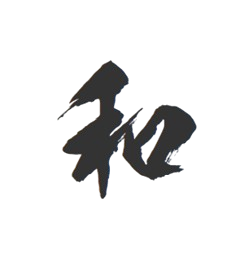
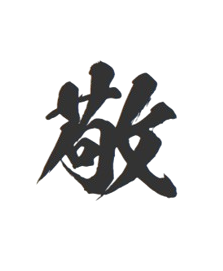
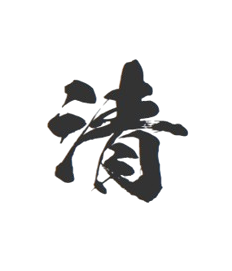
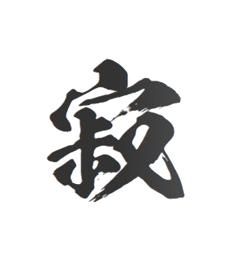
Sen no Rikyu (1522-1591) summarized the principles of Chado into four concepts: wa, kei, sei, and jaku (和敬清寂). These four characters - harmony, respect, purity, and tranquility - express the philosophy at the heart of Chado. They are not simply ideals, but lived experiences that unfold in each shared bowl of tea.
|
Wa (harmony)
|
Wa, or harmony, connotes a feeling of oneness with nature and people. At a tea gathering, harmony plays between host and guest, guest and guest, mood and season, the food served and the utensils used. Sensitivity to the changing rhythms of the seasons, and harmony with these changes are one source of ever deepening pleasure in the practice of Tea. The unpredictable nature of weather is an integral part of a tea gathering and is not to be shut out, ignored, or considered inconvenient. This harmony with nature quietly leads one to an understanding of the evanescence of all things and the unchanging in the changing. |
|
Kei (respect) |
Kei, meaning respect, results naturally from a feeling of gratitude. Respect is extended not only to the other people with whom one interacts but also to one’s daily life, and even to inanimate objects, such as utensils. The etiquette observed in the tearoom helps a student of Tea to learn to apply the principle of kei. To the uninitiated what may appear at first as excessively strict and formal is in actuality a means of incorporating and internalizing the spirit of respect. The hospitality of the host, the concern of the guests for each other and the host, and the careful handling of the utensils exemplify this respect. |
|
Sei (purity)
|
Sei, or purity, in both the physical and spiritual sense, are a very important part of the study of Chado. Rikyu must have learned the importance of simple acts of cleaning in his study of Zen. Even the most mundane acts—washing dishes or cleaning floors—are the seeds of enlightenment. When the host cleans the tea utensils, he or she is simultaneously purifying the heart and mind through total concentration on this task. The guests, before entering the tearoom, pass along a garden path and rinse their hands and wash out their mouths at the low stone water-basin, thereby purifying themselves of the “dust” of the everyday world outside the tearoom. Sei also implies simplification, that is, the elimination of all unnecessary elements. The appearance of the garden path and tearoom are examples of this kind of simplicity. |
|
Jaku (tranquility)
|
From these three previous principles arises Jaku, or tranquility. It is not something forced but rather something that appears quietly when the other principles are present. In this stillness, one feels at ease—fully aware, yet unburdened. Together, Wa–Kei–Sei–Jaku transform the tea ceremony into more than a ritual. It becomes a fleeting moment of connection and clarity, where host and guest share not only tea, but a sense of peace and true presence. |

 English
 Français
 Nederlands